Email Marketing for Saudi Small Businesses: How to Set Up, Build a List and Send Your First Campaigns
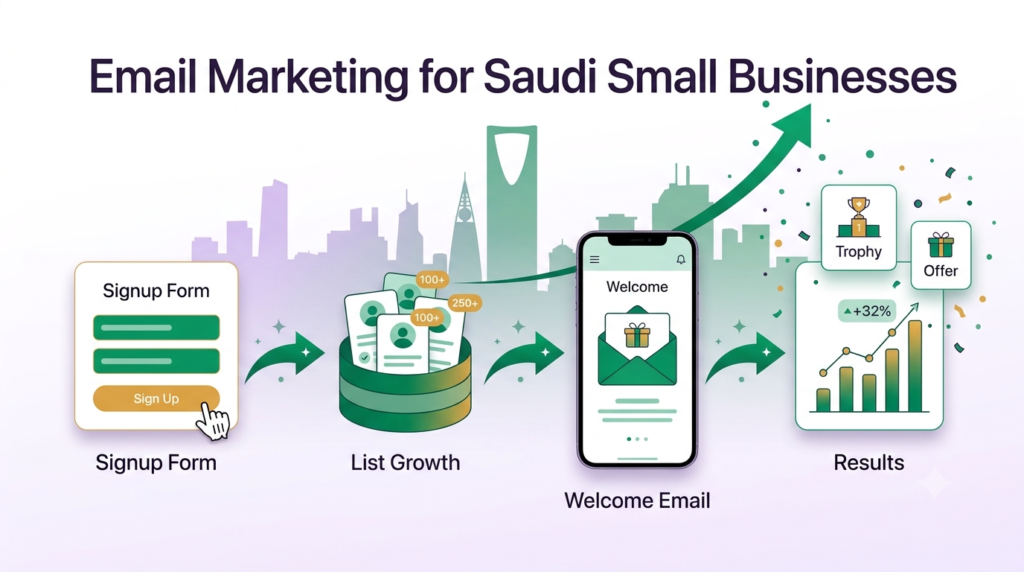
Email marketing for Saudi small businesses is one of the few channels you fully own. Social platforms change their rules and algorithms, but an email list is a direct line to people who have already said they want to hear from you. The problem is that many small businesses skip email because it feels technical, or they start by buying a list and run into trouble.
This guide to email marketing for Saudi small businesses walks you through the setup, how to build a consent-based list, and four first campaigns you can send in your first month.
Why Email Marketing for Saudi Small Businesses Still Works
Email reaches people who chose to hear from you, so it is a good fit when you want repeat customers, bookings and referrals. It works well beside your social media and WhatsApp activity, because you can send longer updates, offers and reminders without depending on an algorithm.
With 34.4 million internet users in late 2025, according to DataReportal’s Digital 2026 report for Saudi Arabia, nearly everyone you want to reach already has an inbox. Email marketing for Saudi small businesses simply gives you a way to stay in it, with permission.
Know the Rules First: Consent and Opt-Out
Compliance comes first in email marketing for Saudi small businesses. Before you collect a single email address, learn the basics. According to Clyde & Co, Saudi Arabia’s Personal Data Protection Law (PDPL) requires consent for direct marketing and an easy way for people to opt out.
A legal overview from Al Tamimi adds that the separate Regulations for Curbing SPAM Messages and Calls also cover promotional emails and SMS, that opting out must be free and straightforward, and that senders must stop within 24 hours of an opt-out request.
Rules are still being refined, so confirm the current text with a Saudi lawyer. In practice, follow these habits:
- Ask for permission before you add anyone to your list.
- Say what you will send and how often.
- Add an unsubscribe link to every email and honour requests quickly.
- Keep a record of when and how each person agreed.
- Never buy or scrape lists.
This is general information, not legal advice.
Step 1: Set Up Your Email Marketing Foundation
A solid setup keeps email marketing for Saudi small businesses simple and reliable.
Choose an email platform
Pick a tool that fits your size and budget. Check these points before you commit:
- It supports Arabic and right-to-left text in templates.
- It includes signup forms, unsubscribe handling and basic automation.
- It lets you tag or segment contacts.
- It has clear pricing for your list size.
- It shows delivery and click reports.
Use a business email address
Send from an address on your own domain, such as hello@yourbusiness.com, not a free personal account. It looks more trustworthy and lets you set up authentication.
Authenticate your domain
Email authentication helps your messages reach the inbox. Google’s email sender guidelines say all senders need SPF or DKIM, and bulk senders who send more than 5,000 messages a day to Gmail users also need DMARC and one-click unsubscribe. Google recommends setting up SPF, DKIM and DMARC for your domains, and your email platform usually shows you the steps.
Set a clear sender name
Use a name people recognise, such as “Noor Cafe” or “Ahmed from Noor Cafe”. Add a reply-to address that a real person reads.
Step 2: Build a Consent-Based Email List
In email marketing for Saudi small businesses, a small list of interested people beats a large list of strangers. Use these sources:
| Where | How | Consent tip |
|---|---|---|
| Website | Signup form in the footer, blog and checkout | Use a clear sentence and an unticked box |
| Shop or clinic | QR code at the counter linking to a form | Explain what you will send |
| Invite customers to join your email list | Ask first and share the link once | |
| Social media | Link in bio to a signup page | Describe the benefit of joining |
| Events | Sign-up sheet or tablet form | Record the date and event |
| Offers | A guide, discount or checklist in return | Keep it optional |
Write a good signup form
- Ask only for name, email and language preference.
- Say what people will get and how often.
- Add a short privacy note and a link to your policy.
- Offer Arabic and English versions of the form.
Step 3: Organise and Segment Your List
Segmentation makes email marketing for Saudi small businesses more relevant without extra work. Even a list of 100 people is easier to serve when you add simple tags:
- Language: Arabic or English.
- Type: new lead, customer or partner.
- Interest: product, service or topic.
- Location: city or district, if it matters for your offers.
Start with two or three segments. You can add more as your list grows.
Step 4: Plan Your First Campaigns
Send these four emails in your first month of email marketing for Saudi small businesses.
- Welcome email (send right away). Say who you are, what to expect and give one useful link or small offer.
- Value email (week 1 or 2). Share a short guide, tips or answers to common questions.
- Offer email (week 3). Promote one real offer or product with a clear deadline and a single button.
- Follow-up email (week 4). Ask for feedback or a review, or remind people about a booking or cart.
A simple welcome email
Subject: Welcome to [Business Name]
Hello [Name],
Thank you for joining [Business Name]. Here is what you can expect: [one line about what you will send and how often].
To start, here is [link to guide, menu or offer].
If you have a question, just reply to this email.
[Your name and business]
You can unsubscribe at any time using the link below.
How to Write Emails People Open
Good writing is half of email marketing for Saudi small businesses.
- Subject line: keep it short, clear and honest. Say what is inside.
- Preview text: add a second line that supports the subject.
- One goal: each email gets one main message and one button.
- Mobile first: most people read on a phone, so use short paragraphs and large buttons.
- Arabic layout: check that right-to-left text and buttons display correctly before you send.
- Timing: Sunday to Thursday is a safe start. Test different times and expect changes during Ramadan.
What to Measure in Email Marketing for Saudi Small Businesses
| Metric | What it tells you |
|---|---|
| Click rate | Whether your message and button are interesting |
| Replies | Whether people feel comfortable talking to you |
| Unsubscribes | Whether you send too much or the wrong content |
| Conversions | Bookings, orders or enquiries from the email |
| Open rate | A rough signal, since mail apps can inflate it |
Review your numbers after each campaign. Keep what works and change one thing at a time.
A 30-Day Launch Plan for Email Marketing for Saudi Small Businesses
- Week 1: Choose a platform, set up your domain authentication and create a signup form.
- Week 2: Add the form to your website, shop and social bio, and send the welcome email.
- Week 3: Send your first value email and your first offer.
- Week 4: Send a follow-up, check your numbers and plan the next month.
Common Mistakes in Email Marketing for Saudi Small Businesses
| Mistake | Why it hurts | Fix |
|---|---|---|
| Buying an email list | Breaks consent rules and damages delivery | Build your own list |
| No unsubscribe link | Legal and trust risk | Add one to every email |
| Sending from a free account | Looks less trustworthy | Use your business domain |
| Only one language | Misses part of your audience | Offer Arabic and English |
| Sending too rarely or too often | People forget you or get annoyed | Set a clear schedule |
| Too many buttons | Readers do not know what to do | Use one main action |
FAQs
Is email marketing for Saudi small businesses legal?
Yes, with consent. The PDPL requires consent for direct marketing and an easy opt-out, and Saudi spam rules also cover promotional emails. Check the current rules with a local lawyer.
How big should my list be before I start?
Start with the people you already serve who agree to hear from you. Even a small list of interested contacts can bring bookings and sales.
How often should a small business send emails?
Once or twice a month is a safe start. Move to weekly only if you have useful content to share.
Should I write emails in Arabic or English?
Use the language your customers prefer, and offer both if you can. Ask for language preference on your signup form.
Conclusion
Email marketing for Saudi small businesses works when you ask for permission, send useful messages and keep the process simple. Remember three things: build your list with consent, authenticate your domain, and send one clear message at a time.
If you want help setting this up, I work as a freelance digital marketing expert in Riyadh and can plan email marketing for Saudi small businesses from the signup form to the first campaign.